Ice at the Eaves: Heat Cable, Roof Rake, Ice Belt or Air Sealing, Compared
Ice at the eave needs snow, heat and cold. UMass weighs each remedy against that, and NOAA's Newark normals show how often a Colonia winter supplies all three. This read lays the options side by side.
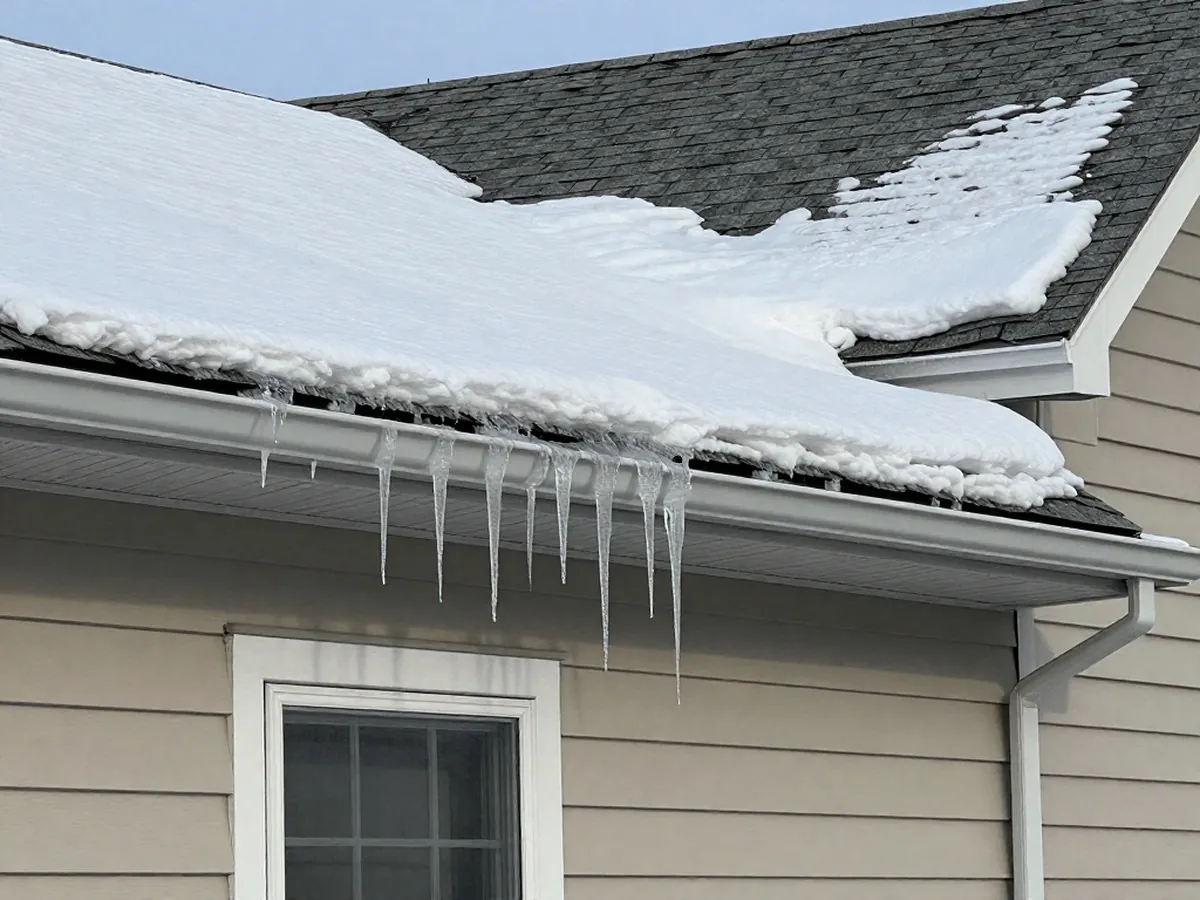
Snow, heat and a cold overhang
Paul Fisette of the UMass building-science program names three ingredients of an ice dam: snow, warmth that melts it and cold that refreezes the meltwater. Heat lost from the house warms the upper part of the roof, while the overhang stays cold, so meltwater runs down and freezes at the edge. Deeper snow and colder weather raise the odds, since snow insulates the roof and holds the heat in. The article dates from 2011 and says some of its information may be outdated.
What the Newark gauge says about a Colonia January
NOAA's 1991-2020 normals for the Newark airport station show a January average of 32.8 degrees Fahrenheit. That month counts 22.6 nights at or below freezing and 7.0 days when the daily high does not rise above freezing. February has 20.0 freezing nights and December 17.5. Yearly snowfall averages 31.5 inches, with 9.1 in January and 10.1 in February. Wikipedia's climate note for Colonia gives a January average of 33 degrees. A January near the freezing line, with snow, is the setup for thaw-and-refreeze cycles. The station is some miles from Colonia, and a given street can differ.
Two snow loads on record
The National Weather Service's summary of the 22-24 January 2016 storm lists 19.0 inches at Woodbridge from a trained spotter, with 27.7 at Metuchen the county's highest. Colonia and Edison are not in that report. The review of 16-17 January 2022 is lighter, 1.0 inch at Hopelawn, though it came with a 66 mph gust. Deep snow is one of the three conditions UMass names, and the January 2016 totals show how deep it can get in the county.
Six ways to meet ice, side by side
| Approach | What it does | What the source says | What it leaves open |
|---|---|---|---|
| Heat cable | Melts a channel through the ice | UMass: it creates an ice dam just above it | The dam re-forms above the cable |
| Chipping or shoveling ice | Takes ice off by hand | UMass: it does more harm than good | Torn shingles and falls from a ladder |
| Roof raking | Pulls snow off the lower roof | UMass: careful raking helps | It removes snow, not the cause |
| Ice belt or membrane | A backup layer under the shingles at the eave | UMass: a band-aid; belts often fail when a second dam forms above them | Warm air still reaches the roof |
| Air sealing and insulation | Keeps house heat out of the attic | UMass: seal first, then roughly R-38 | It means attic work, done once |
| Soffit-to-ridge ventilation | Keeps the roof boards cold | UMass: the most effective approach, with baffles and a 2-inch channel | It needs clear soffits and baffled vents |
Why the heat cable and the hammer do harm
UMass advises against heat cable, saying it creates an ice dam just above it, and not to waste time or money on it; heat tape also wastes energy and can damage shingles. Removing ice with tools or chainsaws, the article says, does more harm than good. Both jobs put someone on a ladder or at the roof edge, and NIOSH puts the U.S. toll from ladder falls above 100 a year. On a flat roof, the Asphalt Roofing Manufacturers Association lists membrane damage from ice movement among the effects of standing water.
Raking, ice belts and the state's ice-barrier rule
Careful raking of snow off the lower roof helps, according to UMass, and NIOSH tells anyone working near utility lines to keep at least 10 feet away. Ice belts often fail when a secondary dam forms above them, and self-adhering membranes under the shingles act as a backup layer the author calls a band-aid. New Jersey's Bulletin 07-3 ties the code's ice-barrier requirement to an average January temperature of 25 degrees or colder, a description it matches to Sussex County. Colonia is outside it, though a roofer may add a membrane at the eaves anyway.
The cold-roof remedy: seal, insulate, vent
UMass names a cold roof as the ideal remedy, with the whole roof held at outdoor temperature. In the article's order, warm air is sealed out first, at wire and plumbing penetrations, light fixtures, attic hatches, chimneys and bath fans; then insulation goes in, roughly R-38 for northern homes, continuous over the exterior walls; then soffit-to-ridge ventilation with baffles and a 2-inch air channel above the insulation. The Department of Energy's brief likewise prefers baffled ridge vents. The article adds that after a dam, wet insulation, damp roof boards and moisture in the wall cavity can cause rot, mold and peeling paint even once the ice has melted. The EPA's mold page says to dry wet materials completely. The Census median house in Colonia dates to 1959, so what a hatch shows about insulation depth is worth noting.
Where does the ice sit on your roof?
Ice only above a heated room points to heat reaching the roof there; ice all along an eave points to the attic as a whole. Photograph it from the ground, then see the ice dams page and the chimney flashing page, since a chimney is one of the places warm air gets in. When you are ready to talk it through, call (732) 568-2812 and mention which eave carries the ice.
Notes from the sources
- UMass Amherst Building and Construction Technology, Preventing ice dams (P. Fisette)
- NJ Department of Community Affairs, Code bulletin 07-3 on ice barrier underlayment
- NOAA NCEI, 1991-2020 monthly normals, Newark Liberty International Airport (USW00014734)
- National Weather Service Mount Holly, January 2016 winter storm snowfall report
- National Weather Service Mount Holly, event review of 16-17 January 2022
- NIOSH, Ladder safety (CDC archive, reviewed 1 March 2024)
- U.S. Department of Energy, Repairing Roofs and Ceilings technical brief
- U.S. EPA, Mold Cleanup in Your Home
- Asphalt Roofing Manufacturers Association, Ponding water basics (2017)
- Wikipedia, Colonia, New Jersey
- U.S. Census Bureau, ACS 2020-2024 5-year, table B25035 (median year built), Colonia CDP
Checked 1 Nov 2026